





































| INDUSTRY | EXPERTISE | COUNTRY |
| Transportation Infrastructures |
| Business Applications
|
| Axians Poland |
For passengers, a platform display or station announcement may appear simple. Behind every update, however, several systems must exchange information, from train detection equipment and operational workstations to displays and loudspeakers. The challenge is to ensure that this information moves reliably across the station and remains consistent at every passenger touchpoint.
A Dynamic Passenger Information System (DPIS) brings these components together by automatically generating and distributing real-time passenger information across multiple channels. It ensures that consistent, up-to-date information reaches passengers through visual displays and audio announcements, while also supporting station staff through dedicated operational workstations.
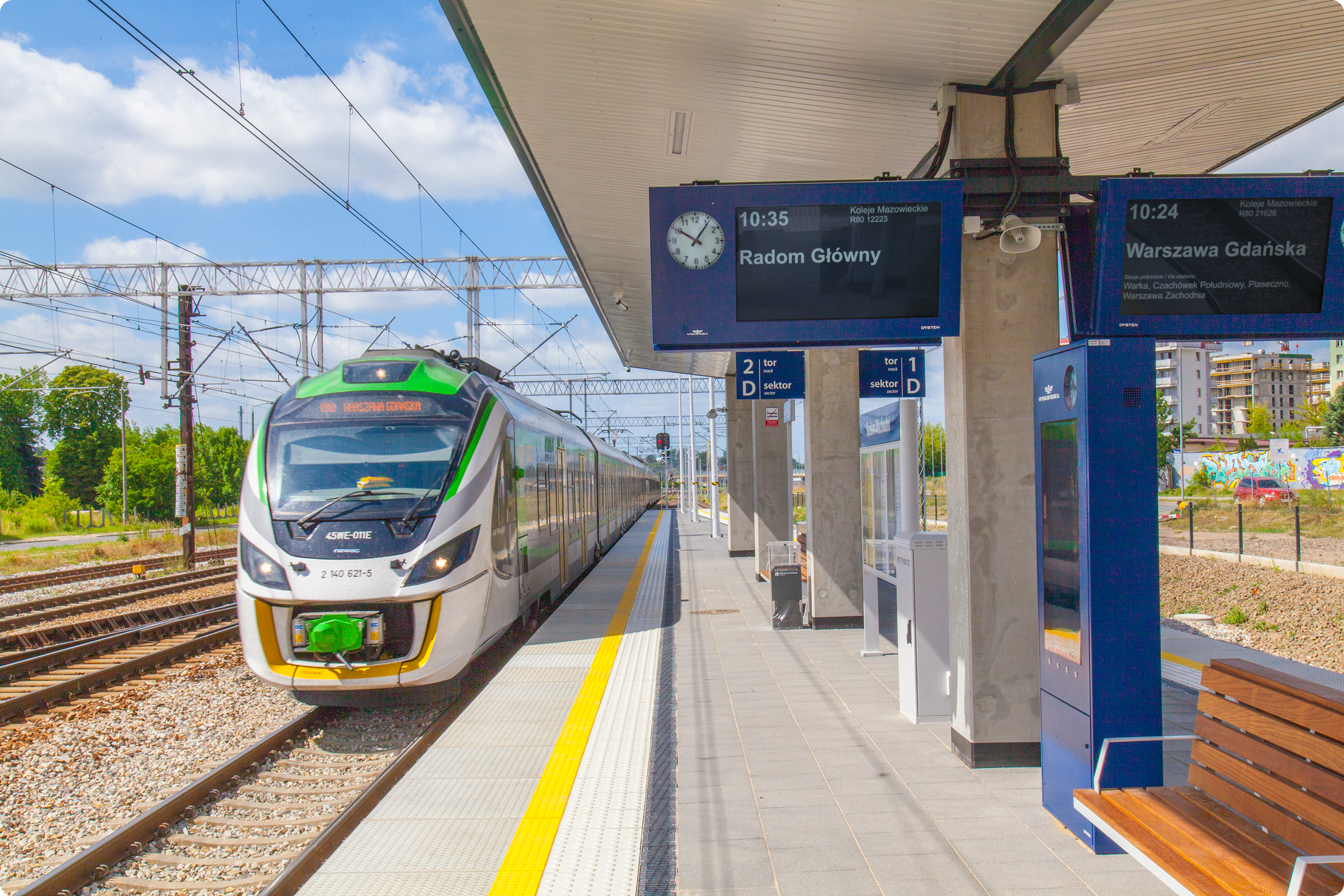
This was the objective behind the modernization of Radom Wschód railway station in Poland. As part of a wider railway infrastructure program, Axians designed, installed, integrated and commissioned a complete Dynamic Passenger Information System, Video Monitoring System and Public Address System.
The implementation included 12 platform-edge displays, four entrance displays, two multifunction displays, four train detection sensors, 35 CCTV cameras and 62 public address loudspeakers. A dedicated monitoring and announcement workstation was also installed at the Radom Local Control Centre.
Behind these visible systems lies an extensive communications infrastructure. Approximately 10 kilometers of structured cabling, fiber-optic, power and loudspeaker infrastructure connect the different components, enabling visual and audio information to be delivered throughout the station while supporting security and daily operations.
The project’s complexity lies not only in the scale of the installation, but in bringing every element together. Passenger displays, train detection equipment, CCTV, public address systems and communications infrastructure all had to operate reliably within the same environment.
The successful delivery at Radom Wschód strengthened the team’s expertise in integrated railway information systems and provided a valuable foundation for the next challenge.
Scaling integrated systems for a major railway hub
That next challenge is taking shape in Częstochowa, where Axians (ATEM-Polska in Poland) is delivering a project of significantly greater scale.
As the main contractor, the company is responsible for designing and implementing a Central Dynamic Passenger Information System and Video Monitoring System for PKP Polskie Linie Kolejowe S.A., Railway Lines Division in Częstochowa.
The scale of the project reflects the demands of a major railway hub. The planned implementation includes 33 platform-edge displays, 13 entrance displays, 11 multifunction displays, 12 station clocks, 10 train detection sensors and 276 CCTV cameras. It also covers 17 telecommunications cabinets, a dedicated observation workstation for the Railway Protection Guard, and a public address system operated from a workstation at the Częstochowa signal box. Approximately 28 kilometers of cabling infrastructure will connect and support these systems.
Although the Częstochowa project is currently in the design phase, many of its engineering priorities build directly on the work completed at Radom Wschód. Reliable communication between multiple systems, consistent passenger information and an efficient operating environment remain central to the project. Lessons from the earlier implementation are therefore helping to shape both design decisions and the approach to delivery.
Together, the two projects demonstrate how experience gained at one station can support greater ambition at the next. By combining proven engineering expertise with integrated system design, Axians is helping railway operators manage increasingly complex station environments and ensuring passengers receive the information they need throughout their journey.

Explore More Customer Stories
-

Building the digital foundation of an urban transport operator
ReadThe continued digitalization of metropolitan transport is increasing the need for reliable, secure connectivity across stations, operational environments, and other critical locations. As the number of connected endpoints, corporate services, and operational applications grows, networks must meet these demands while accommodating future systems without compromising availability, performance, or security.
-
From one station to the next: Scaling smarter passenger information
ReadFor passengers, a platform display or station announcement may appear simple. Behind every update, however, several systems must exchange information, from train detection equipment and operational workstations to displays and loudspeakers. The challenge is to ensure that this information moves reliably across the station and remains consistent at every passenger touchpoint.
-

Smart mobility in Lisbon: Axians’ digital payment innovation with Carris
ReadLisbon’s public transport operator, Carris, set out to modernize its fare collection. With the rising demand for seamless, fast, and secure urban mobility, the existing ticketing methods no longer aligned with the habits of all modern passengers. Carris needed a solution that would improve user experience, simplify operations, and support Lisbon’s evolution into a smart city.
-
Axians Italia develop an innovative solution for an automated underground system
Readinnovative solution for an automated underground system
-
How Rotterdam becomes the smartest port in the world
ReadThe port of Rotterdam will create a digital twin of the port to track ship movements, infrastructure, weather, geographic and water data.
-

Rotterdam sent hyper-smart container on trip around the world
ReadContainer 42 departed from Rotterdam on a two-year data collection trip. During its journey around the world, its sensors collected intelligent data. It measured vibration levels, incline, and position, while also providing data on noise, air pollution, humidity, and temperature. The Container had solar panels which demonstrated how much energy could be harvested on container ships, trains, or trucks. The first stop for Container 42 was Munich, where it appeared at the Transport Logistic event in June 2019.